1960
The Dark Half1960 is the year of Thad Beaumont’s childhood brain operation and the first documented convergence of his neurological symptoms with the sparrows that recur throughout the story. Doctors attributed his severe headaches and seizure to tissue from an incompletely absorbed twin growing in his prefrontal lobe; the operation removed the lesion, but a flock’s collision with the hospital windows, timed just before Thad awoke, leaves the event poised between clinical explanation and supernatural pattern.
Illness and diagnosis
Thad’s headaches began in August, when he was eleven. At first mild, they worsened by the reopening of school in early September into prolonged episodes that left him lying in a darkened room. By the end of that month he hoped the pain would kill him; by mid-October he feared it would not. His mother took him to Dr. Seward, and the eventual operation followed a seizure caused by a mass in the prefrontal lobe.
The doctors initially treated the mass as a tumor. In the explanation later given to Alan Pangborn, Pritchard described it instead as part of Thad’s twin: fetal tissue that had not been fully absorbed in the womb and had remained in the brain. Such absorption was not unusual, he said, but tissue left behind in this way was rarer, and its location and renewed growth were unusual. He speculated that an early onset of puberty might have set the tissue growing again. The pressure inside the skull accounted for the headaches and the seizure, giving the operation a medical cause without explaining every detail surrounding it.
The sparrows and the operation
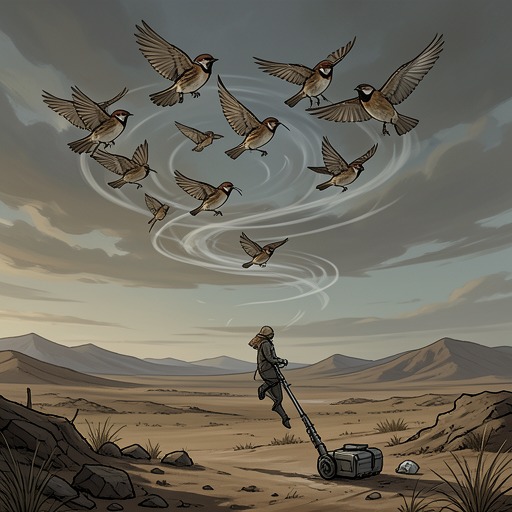
Before his headaches, Thad heard a phantom sound like distant birds. He sometimes thought he could see sparrows gathered on telephone wires and rooftops. Years later, he identified the birds as an auditory sensory precursor: a symptom associated with the brain condition, rather than an independent event. Pritchard also recalled that Thad remembered seeing the birds after the operation, when he described them across the houses, lawns, and streets of Ridgeway, the Bergenfield neighborhood where he lived.
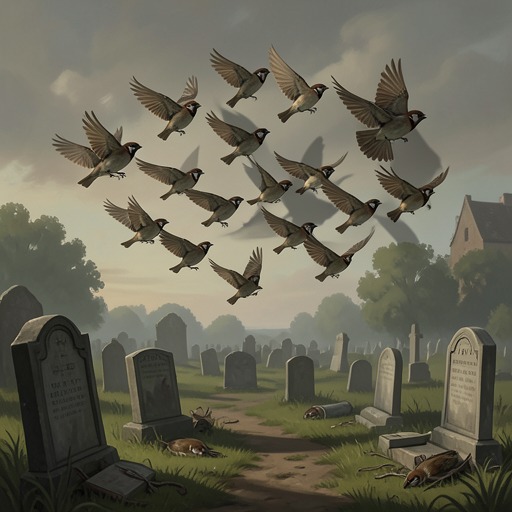
The hospital incident occurred on October 28, 1960. Shortly after two in the afternoon, an exceptionally large flock flew into the west side of Bergenfield County Hospital, where the Intensive Care Unit was then located and where Thad had been taken after surgery. The collision broke many windows; maintenance workers later cleared away more than three hundred dead birds. A newspaper report recorded the incident, while an ornithologist suggested that sunlight reflected by the building’s largely glass west side had attracted the flock. He also proposed that flocking behavior could lead the birds to follow one another into the glass.
Pritchard’s recollection gives the event a precise, troubling sequence. The flock struck the hospital at about 2:05; Thad woke at about 2:10, perhaps a little earlier. An ICU nurse believed that the breaking glass had awakened him. Thad had heard and seen birds before the operation, and after it reported birds throughout his neighborhood. The timing links his recovery to the flock without establishing that he caused the collision or that the birds were responding to him.
How the memory returns
The medical history re-enters the narrative when the sparrows recur in Thad’s adult life. After hearing their sounds again, he made an appointment with Dr. Hume, who knew that the 1960 lesion had been removed. Thad reported two returns of the bird sounds that had preceded his childhood headaches, while saying the headaches themselves had not returned. He did not tell Hume about his trance state, his writing during it, or writing found on a murder victim’s apartment wall. Hume nevertheless treated the recurrence seriously and ordered brain imaging, including a cranial X-ray series and a CAT scan.
The 1960 diagnosis also enters the investigation through the evidence surrounding Homer Gamache’s murder. A fingerprint recovered from Homer’s truck matched Thad’s service record, making his childhood medical history relevant to Pangborn’s effort to understand why evidence pointed toward him. Thad, drawing on research he had done for his Stark novels, questioned whether the quality and completeness of the prints should be trusted. He asked about the required points of comparison; Pangborn answered that Maine required six perfect comparisons for a fingerprint to be admitted as evidence. That exchange frames the old operation alongside a present-day problem of evidence: the match is consequential, but it does not by itself explain how Thad’s prints came to be associated with the crime.
Medical fact and supernatural pattern
When Pritchard recounts the history to Pangborn, the ordinary medical account becomes a disclosure with larger consequences. The lesion was not cancer but residual twin tissue; the childhood birds had a recognized possible relation to neurological symptoms; and the hospital’s broken windows and dead sparrows were independently recorded. Yet the precise interval between the flock’s impact and Thad’s waking, together with his report of birds around Ridgeway, makes the episode more than a detached medical anecdote. It is an early instance in which a bodily condition and an event involving real birds occupy the same narrow stretch of time.
The recurrence complicates, rather than simply cancels, the diagnosis. Thad’s childhood headaches and seizure had an anatomical cause, and the operation removed the lesion. Later bird sounds return without the old headaches, prompting examination even as Thad tries to dismiss what happened during his adult episodes. The story thus preserves two accounts at once: clinical explanations for the childhood illness, and an unresolved pattern in which sparrows appear at consequential moments.
That pattern reaches its final significance when the birds return in force during the confrontation with George Stark. At Gold’s Junkyard and Auto Supply, Thad and Rawlie DeLesseps discover sparrows covering the stacked vehicles, though Thad has heard none arrive. Later, Pangborn sees the birds gather near the Williamses’ driveway and wonders whether the area is their staging ground; one lands on his shoulder and hops onto his hand before returning to the flock. On the road, Thad encounters a sharp boundary where the birds begin, and a sparrow peers into the VW. In the final confrontation, Thad understands the psychopomps as Stark’s escort back to the land of the dead. The 1960 hospital incident cannot, by itself, explain those later events, but it establishes the early conjunction of Thad, medical crisis, and flocking sparrows that gives their return its accumulated weight.